SOUTHERN BOOBOOK
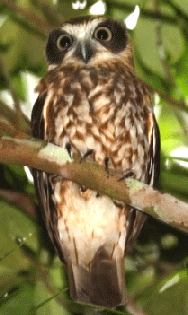
Red Boobook Photo
Courtesy of Michael Todd
michaelktodd@bigfoot.com

SOUTHERN BOOBOOK: Ninox novaeseelandiae 32 cm ( Red Boobook Rainforest variety) - A nocturnal species that lives in woodlands, grasslands and rainforests.
Part of the "hawk owl" group of owls. In Australia the Southern Boobook occurs in all regions, but a dark form is endemic to rainforests of the Wet Tropics region. Named the Red Boobook, it may ultimately prove to be a distinct species. It is a nocturnal species that lives in forests and woodlands. During the day, birds roost singly in tree hollows or dense foliage. Owls have good night vision, but rely also on their excellent hearing - which is up to four times better than any other animal tested, allowing some to hunt in complete darkness. Because their left and right ears are placed at different levels on their heads there is a slight difference in the time taken for a particular sound to reach each ear. This time-lag enables the owl to pinpoint the source of the sound more accurately. The higher ear has an opening facing downwards and is more sensitive to sounds from below. Feathers within the characteristic facial disc are positioned so as to funnel sound to the ears. Stiff feathers bordering the ear slits are attached to moveable flaps so an owl can change the shape of its ear opening and focus its hearing. (Source: Environmental Protection Agency) When swooping on its prey on of the owl's outer toes can be brought around so the four talons grip from four different directions. Large amounts of indigestible fur, feathers and bones are swallowed but once or twice a day these items are regurgitated, in tightly-packed pellets. Researchers can often learn a lot about animals living in a particular area by examining these pellets; bones of the rarely-trapped prehensile-tailed rat are the only indication that it is more common than sightings would suggest. (Source: Environmental Protection Agency) In addition to their excellent hearing, owls have, like other birds of prey, much better vision than humans. The owl's eye is packed with rod cells which are sensitive to low light levels and its large pupil means that an image is about two and a half times brighter to an owl than to a human. (Source: Environmental Protection Agency) Hawk owls, which have incomplete facial discs and very large eyes, have relatively better night vision than hearing. They hunt by perching, looking and diving, then carrying their prey in their talons and tearing it up before eating. (Source: Environmental Protection Agency) Because insects form a large part of its diet, nesting begins in spring. This is accompanied by frequent bouts of calling. The familiar ‘boobook’ or ‘mopoke’ double hoot is the best known of Australian nocturnal sounds. The Red Boobook is heard calling most nights round Chambers Wildlife Rainforest Lodge .
RETURN TO BIRD INDEX
|

